
Carbon Dioxide Laser Resurfacing
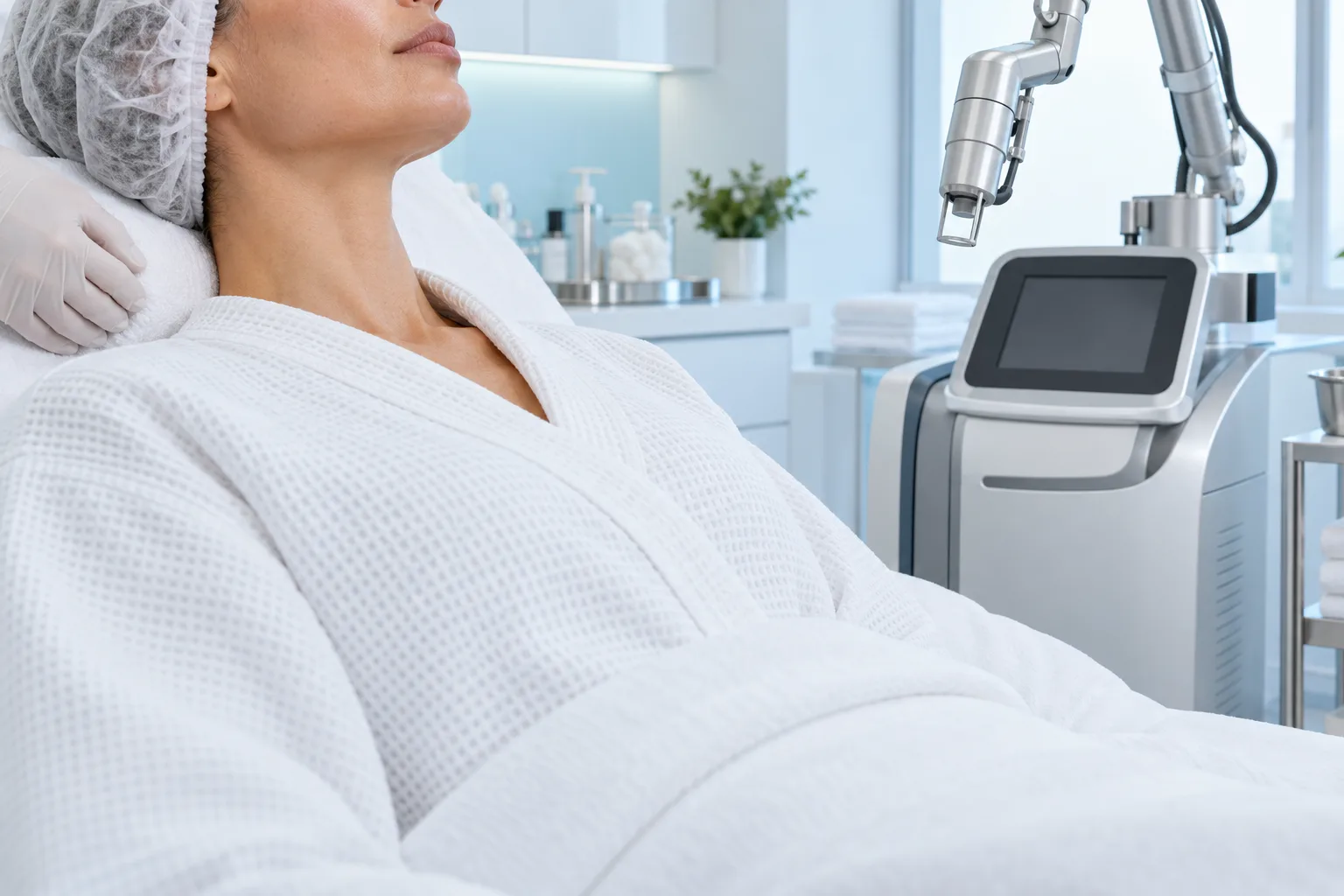
The smallest details of carbon dioxide laser resurfacing are the ones people read about last: how long the redness stays, how the skin is kept clean and what bumps appear during healing.
Carbon dioxide laser resurfacing removes thin layers of skin with a laser, and much of what matters to a patient happens before and after the laser is switched on. The sections below follow the treatment in order: what the laser does, how the procedure goes, how the skin heals, the small problems worth watching for, the color changes and how to protect the result.
What the laser does and what it treats
Cleveland Clinic says carbon dioxide lasers very precisely remove thin layers of skin with minimal heat damage to the surrounding structures. Cleveland Clinic lists the conditions they treat as wrinkles, photodamage, scars, warts, linear epidermal nevi (birthmarks) and rhinophyma (enlarged oil glands on the nose).
Cleveland Clinic also says a new generation of carbon dioxide lasers uses very short-pulsed light energy (ultrapulsed) or continuous light beams delivered in a scanning pattern, and that this technology has revolutionized the ability to rejuvenate sun-damaged, wrinkled skin.
The dermatology society's page on laser resurfacing places this laser among other resurfacing approaches, which helps when you compare it with gentler options.
The day of the procedure
Cleveland Clinic says carbon dioxide laser resurfacing is usually performed on an outpatient basis, using local anesthesia with sedative medications given by mouth or through a vein, and that general anesthesia may be used when the entire face is treated. Cleveland Clinic adds that wrinkles around the eyes, mouth or forehead may be treated individually, or a full-face resurfacing may be performed.
On timing, Cleveland Clinic says a partial-face resurfacing takes 30 to 45 minutes and a full-face treatment takes one-and-a-half to two hours.
Ask whether the plan covers one area or the whole face. That answer sets the time in the chair and the kind of anesthesia you will be asked about.
Healing at home
Cleveland Clinic says a non-stick dressing is applied to the treatment sites for 24 hours, and that you may be instructed to clean the treated areas two to five times a day with saline or a dilute vinegar solution and then apply an ointment. Cleveland Clinic says this wound care is meant to prevent scabs from forming, because scabs can increase the chance of scarring and prolong healing time.
Cleveland Clinic says the areas generally heal in 10 to 21 days, depending on the condition treated and the intensity of the laser settings, and that stronger settings mean a longer recovery.
That makes aftercare a daily job for the first weeks. Ask for the instructions in writing, ask whom to call when something looks wrong and plan time at home. Cleveland Clinic's page on carbon dioxide laser resurfacing sets out the aftercare in full and is worth reading before the consultation.
Small bumps, flares and cold sores
Cleveland Clinic says milia, which are small white bumps or cysts, may appear in the laser-treated areas during healing, and that acne flares may occur after laser resurfacing. Cleveland Clinic says milia can be removed by gentle cleansing with a washcloth or by a dermatologist in the office, and that an acne flare may resolve on its own or be treated with conventional acne therapies.
Cleveland Clinic says a herpes simplex cold sore may reactivate, especially after laser resurfacing around the mouth, and that this can be prevented by giving an antiviral medicine before the procedure and continuing it for seven to 10 days afterward.
A new bump or flare during healing is a good reason to call the clinic and ask. If you get cold sores, say so at the consultation so the antiviral question is settled early.
Redness and color changes
Cleveland Clinic says the redness in laser-treated sites generally fades in two to three months but may take as long as six months to disappear, and generally persists longer in blondes and redheads.
Cleveland Clinic says patients with darker skin tones have a greater risk of healing with darker pigmentation, called hyperpigmentation, although anyone can be affected after laser treatment. Cleveland Clinic says hyperpigmentation, and more rarely hypopigmentation, may result in the laser-treated areas, that hyperpigmented areas may be treated with bleaching cream to ease fading, and that hypopigmentation is more difficult to treat.
Color is the slowest result to read. Ask what the provider will do at each stage if the skin heals darker or lighter, and which changes they want to hear about.
Protecting the new skin
Cleveland Clinic says daily sunscreen application is necessary after healing to protect the newly laser-resurfaced skin. Cleveland Clinic recommends a broad-spectrum sunscreen that screens both ultraviolet B and ultraviolet A rays, made for use on the face, with a sun protection factor of at least 30.
That adds a daily step to the routine. Ask the clinic how long to keep it up and which product it suggests.
Weighing the decision
Carbon dioxide laser resurfacing is a decision best made after reading more than one source and asking direct questions. The plastic surgery society's page on laser skin resurfacing approaches the topic from the surgeon's side and gives a second view to compare.
Write down your questions on anesthesia, aftercare, redness, color changes and sun protection, and bring them to the consultation. Do not book until the answers are clear.